In September 2015, following a historic and extensive negotiation and consultation process, the 193 Member States of the United Nations (UN) adopted the 2030 Agenda for Sustainable Development (the 2030 Agenda)[1] to guide development efforts around the world. A global 15-year plan of action to end poverty, protect the planet and ensure prosperity for all, while strengthening universal peace in larger freedom, the 2030 Agenda includes an ambitious set of 17 Sustainable Development Goals (SDGs) and 169 targets. It also contains the central and transformative pledge that “no one will be left behind” and the “endeavour to reach the furthest behind first.”[2] Focused on the economic, social and environment dimensions of sustainable development, the 2030 Agenda is universal in its nature, with the SDGs applicable to all countries – developed and developing alike – regardless of their level of development.
Building upon its predecessor, the Millennium Development Goals (MDGs), the SDGs address a number of important issues not previously covered by the MDGs. Most notably, the inclusion of a stand-alone goal focused on fostering peaceful, just and inclusive societies is considered by many to be a groundbreaking achievement within the new development framework. The existence of SDG 16, which seeks to “promote peaceful and inclusive societies for sustainable development, provide access to justice for all and build effective, accountable and inclusive institutions at all levels”[3] was the result of hard-fought efforts by Member States, civil society and other key stakeholders for formal recognition of the importance of democratic governance, peace and security, and the rule of law – including the protection of human rights – to sustainable development.[4]
The 2030 Agenda and its commitment to peaceful, just and inclusive societies is complemented by several other global development agreements including the Paris Agreement on Climate Change[5], the Sendai Framework on Disaster Risk Reduction[6], the New Urban Agenda[7] and the Addis Ababa Action Agenda[8], the latter which provides a global framework for financing sustainable development.
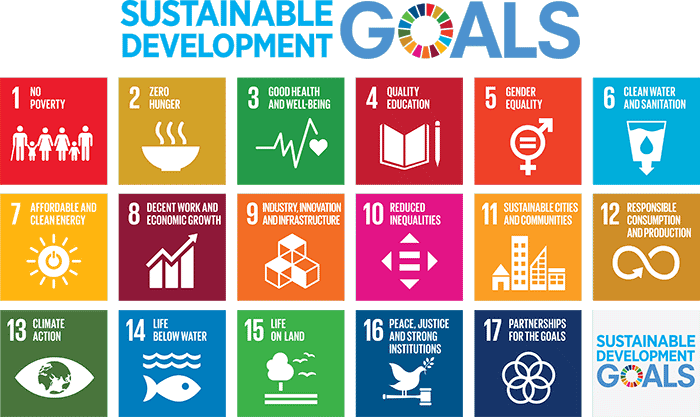
In September 2015, following a historic and extensive negotiation and consultation process, the 193 Member States of the United Nations (UN) adopted the 2030 Agenda for Sustainable Development (the 2030 Agenda)[1] to guide development efforts around the world. A global 15-year plan of action to end poverty, protect the planet and ensure prosperity for all, while strengthening universal peace in larger freedom, the 2030 Agenda includes an ambitious set of 17 Sustainable Development Goals (SDGs) and 169 targets. It also contains the central and transformative pledge that “no one will be left behind” and the “endeavour to reach the furthest behind first.”[2] Focused on the economic, social and environment dimensions of sustainable development, the 2030 Agenda is universal in its nature, with the SDGs applicable to all countries – developed and developing alike – regardless of their level of development.
Building upon its predecessor, the Millennium Development Goals (MDGs), the SDGs address a number of important issues not previously covered by the MDGs. Most notably, the inclusion of a stand-alone goal focused on fostering peaceful, just and inclusive societies is considered by many to be a groundbreaking achievement within the new development framework. The existence of SDG 16, which seeks to “promote peaceful and inclusive societies for sustainable development, provide access to justice for all and build effective, accountable and inclusive institutions at all levels”[3] was the result of hard-fought efforts by Member States, civil society and other key stakeholders for formal recognition of the importance of democratic governance, peace and security, and the rule of law – including the protection of human rights – to sustainable development.[4]
The 2030 Agenda and its commitment to peaceful, just and inclusive societies is complemented by several other global development agreements including the Paris Agreement on Climate Change[5], the Sendai Framework on Disaster Risk Reduction[6], the New Urban Agenda[7] and the Addis Ababa Action Agenda[8], the latter which provides a global framework for financing sustainable development.
Transparency, Accountability &
Participation (TAP) Network
Address: 205 E 42nd St.
New York, NY 10017
Email:
secretariat@tapnetwork2030.org